How a roof survey works, start to finish.
Every engagement follows the same disciplined path — from scope to a documented, color-mapped report you can use for budgeting, repairs, warranty, or a claim.
Scope & access
We review the building, roof type, and history, then plan safe roof access and the survey grid.
Non-destructive survey
Instruments scan the assembly to locate trapped moisture and wet insulation without cutting the roof apart.
Verification cores
Where needed, selective core samples confirm readings and establish dry/wet baselines for accuracy.
Report & color map
You receive a written report of findings and recommendations, with a color graph marking any problem areas.
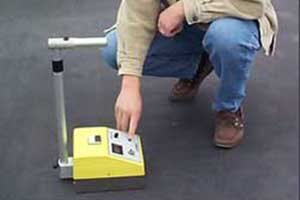
5×5 Bell Chamber testing
For wind-uplift evaluation, we use 5×5 Bell Chamber testing under Testing Application Standard (TAS) 124-95, performed in conjunction with Irving Abcug, P.E., a Florida-registered and licensed engineer. The procedure determines the uplift resistance of an adhered or mechanically attached roof assembly to the deck.
The calculated pressure applies to the entire roof system. This procedure determines attachment rates for the field of the roof; the higher pressures required at corners and perimeters — where wind damage concentrates — are calculated separately.
Roof Moisture Surveys have proven to be a very effective method for improving the long-term performance and reducing the life-cycle cost of roofing systems. It is generally agreed that it is technically unwise and fiscally irresponsible to develop plans for the maintenance, repair, or replacement of a roof without first conducting a Roof Moisture Survey.— U.S. Army Corps of Engineers, The Military Engineer, April 1982, Vol. 74, No. 479
Ready to schedule?
We’ll map your roof and hand you a report you can act on.